
Overview
The estimation of subnational PPPs (sPPPs) starts with the item-level prices that are progressively aggregated to higher levels. In addition to aggregate subnational price indices, sub-indices, for example, at the COICOP division level, can highlight more granular regional price level differences. This process aligns with current recommendations; see ICP (2021), Bank (2013) and European Union/OECD (2024) for more information.
Estimation steps
The estimation steps are:
Estimation of basic headings using item-level prices, where price data are aggregated up to the level of basic headings, generally without the use of expenditure weights (unless such information is available, for instance, when retail scanner data provide detailed transaction-level records).
Estimation of higher-level aggregates using basic heading indices to higher levels of the classification hierarchy, at which point household expenditure data are accessible and can be applied as weighting factors.
To seamlessly combine the two estimation steps, OECDsppps, provides the ‘linking function’ estim_index_link() to impute missing basic-heading subnational PPPs. A complete sylised workflow is described in section Putting it all together.
Estimation methods
The choice of estimation method depends on the availability of data and the analytical objectives of the subnational PPP exercise. When the aim is to ensure cross-country comparability and to exploit micro-level price information, the Country-Product-Dummy - Gini-Éltetö-Köves-Szulc (CPD-GEKS) approach offers a flexible framework for estimating basic-heading indices (ICP 2021), where the first estimation step to the basic-heading level is performed using the CPD method, and further aggregation beyond the basic-heading level is carried out using GEKS. Basic-heading aggregation with CPD is recommended by the ICP (ICP 2021) as it is better-suited to handling missing price observations in the underlying price microdata than GEKS (Auer, Ludwig von 2026).1
In contrast, the Eurostat-OECD (Jevons-GEKS) method employed at the national level imposes more stringent data requirements. Such requirements may be more difficult to meet in the context of deriving subnational PPPs based on existing microdata, particularly regarding the representativeness of individual products across all regions (European Union/OECD 2024).
The estimation procedure in this vignette follows the CPD-GEKS approach and highlights its similarities and differences with the Jevons-GEKS approach whenever instructive. For a more comprehensive discussion on price indices see Bank (2013) and European Union/OECD (2024).
1 Estimation of basic headings using item-level prices
1.1 Overview
The CPD method is a regression-based approach for estimating price parities. The underlying statistical model is
\[p_{ij} = PPP_j \times p_i \times \epsilon_{ij} \tag{1}\]
where \(PPP_j\) is the purchasing power parity of an arbitrary region \(j\), (\(r = 1,...,j,...,R\)), \(p_i\) is the average cross-regional price of the same arbitrary commodity \(i\), (\(n = 1, ..., i, ... N\)), and \(\epsilon_{ij}\) is an independently and identically distributed random variable.2 Taking logs of Equation 1 yields
\[\begin{aligned} ln p_{ij} & = ln PPP_j + ln p_i + ln \epsilon_{ij} \\ & = \alpha_j + \gamma_i + ln \varepsilon_{ij} \end{aligned} \tag{2}\]
where \(\alpha_j\) is the price level of region \(j\) relative to all other regions in the comparison. \(\alpha_j\) can also be expressed relative to a reference region, for example, the national price level. Then, \(\alpha_j\) represents the subnational purchasing power parity of region \(j\) given by \(\hat{PPP}_j = exp(\hat{\alpha}_j)\).
1.2 Estimation
The CPD model in Equation 2 may be interpreted as a fixed-effects specification, in which the region effects yield estimates of subnational Purchasing Power Parities, while commodity-specific effects generate estimates of subnational price levels. The model can be written as a regression equation in which all explanatory variables take the form of dummy indicators for each region and commodity.
\[\begin{aligned} ln p_{ij} = & \alpha_1 D_1 + ... + \alpha_j D_j + ... +\alpha_R D_R + \\ & \eta_1 \mathcal{D}_1 + ... + \eta_i \mathcal{D}_i + ... + \eta_N \mathcal{D}_N + \varepsilon_{ij} \end{aligned} \tag{3}\]
and \(\varepsilon_{ij}\) are independently and identically (normally) distributed with a zero mean and variance \(\sigma^2\), that is, \(\varepsilon_{ij} \sim N(0, \sigma^2)\). The variables of interest, \(PPP_j\), can be estimated through the parameters \(\hat{\alpha}_j\) using ordinary least squares (OLS).
1.3 Implementation
This section describes the implementation of the CPD using different approaches from simple cross-tabulations, standard OLS as well as using the pricelevels package (Weinand 2025) and finally the function estim_cpd() of this package using examples 1 and 2.
Examples 3 to 6 discuss further functionalities of estim_cpd().
Example 1: One product, two regions
1.3.1 Using cross-tabulations
In the CPD regression model, the intercept corresponds to the cross-regional average.
The coefficient estimate is the price ratio of the average regional prices.
1.3.2 Using pricelevels
The same results can be obtained using cpd() from the pricelevels package.
# With pricelevels - estimation with respect to regional average
df1[, cpd(p = price, r = region, n = product, q = NULL, base = NULL)]
#>        1        2
#> 0.942809 1.060660
1.060660 / 0.942809
#> [1] 1.125

# With pricelevels - estimation with respect to region 1
df1[, cpd(p = price, r = region, n = product, q = NULL, base = "1")]
#>     1     2
#> 1.000 1.125

# With pricelevels - estimation output
df1[, cpd(
  p = price, r = region, n = product, q = NULL, base = NULL,
  simplify = FALSE
)]
#>
#> Call:
#> stats::lm(formula = cpd_mod, data = pdata, singular.ok = FALSE)
#>
#> Coefficients:
#> (Intercept)        lnP.1
#>     3.23695     -0.05889
exp(-0.05889)
#> [1] 0.9428105
1.3.3 Using standard OLS
The same can be achieved with a simple OLS regression
# With OLS
pdata <- df1

# Model: add intercept to for price levels relative to base
cpd_mod <- log(price) ~ region + 1

# Transformation: equiv to "mean centring" of continuous predictor: shifting
## dummy encoding to -1/1 intercept is mean across all prices.
## Region1 is the 'main effect', i.e., the difference between levels of a given
## factor (region) across all other factors.
contrasts(x = pdata$region) <- contr.sum(levels(pdata$region))
colnames(contrasts(x = pdata$region)) <- levels(pdata$region)[-nlevels(pdata$region)]

# OLS regression
out <- lm(formula = cpd_mod, data = pdata)
out
#>
#> Call:
#> lm(formula = cpd_mod, data = pdata)
#>
#> Coefficients:
#> (Intercept)      region1
#>     3.23617     -0.05898
exp(dummy.coef(out)[["region"]])
#>        1        2
#> 0.942723 1.060757
exp(3.23617 - 0.05898)
#> [1] 23.97928
exp(3.23617 + 0.05898)
#> [1] 26.98146
Example 2: Two products, two regions
The procedure is identical for the more general case.
1.3.4 Using pricelevels
# With pricelevels ------
## Estimation with respect to regional average
df2[, cpd(p = price, r = region, n = product, q = NULL, base = NULL)]
#>        1        2
#> 0.942723 1.060757
1.060757 / 0.942723
#> [1] 1.125205

## Estimation with respect to region 1
df2[, cpd(p = price, r = region, n = product, q = NULL, base = "1")]
#>        1        2
#> 1.000000 1.125205

## Estimation output
df2[, cpd(
  p = price, r = region, n = product, q = NULL, base = NULL,
  simplify = FALSE
)]
#>
#> Call:
#> stats::lm(formula = cpd_mod, data = pdata, singular.ok = FALSE)
#>
#> Coefficients:
#>     pi.1      pi.2     lnP.1
#>  3.27554   3.19680  -0.05898
exp(-0.05898)
#> [1] 0.9427256
1.3.5 Using standard OLS
# OLS ------
## Data
pdata <- df2
## Model
cpd_mod <- log(price) ~ product + region - 1

## Transformation: equiv to "mean centring"
contrasts(x = pdata$region) <- contr.sum(levels(pdata$region))
colnames(contrasts(x = pdata$region)) <- levels(pdata$region)[-nlevels(pdata$region)]

## OLS regression
out <- lm(formula = cpd_mod, data = pdata)
out
#>
#> Call:
#> lm(formula = cpd_mod, data = pdata)
#>
#> Coefficients:
#> product1  product2   region1
#>  3.27554   3.19680  -0.05898
exp(dummy.coef(out)[["region"]])
#>        1        2
#> 0.942723 1.060757
1.3.6 Integration in using estim_cpd()
provides the function estim_cpd() for CPD estimation. The function provides nummerically identical results as the previously discussed estimations and provides further functionalities; see the examples below as well as the documentation of estim_cpd() for more information.
Example 3: Multiple products and regions, with and without weights
CPD with no weights using cpd() in pricelevels (Weinand 2025) and estim_cpd().
# Estimating sPPPs with `pricelevels`, no weights --------
as.data.table(sampledata_prices)[, cpd(p = price, r = region, n = product)]
#>  region_1  region_2  region_3  region_4  region_5
#> 1.1970918 1.0000753 0.9599226 1.1393190 0.7637624

# Estimating sPPPs with `estim_cpd()`, no weights ---------
sampledata_prices |>
  estim_cpd(
    region = "region",
    product = "product",
    price = "price"
  ) |>
  pull("sPPP")
#>  region_1  region_2  region_3  region_4  region_5
#> 1.1970918 1.0000753 0.9599226 1.1393190 0.7637624
CPD with weights using cpd() in pricelevels (Weinand 2025) and estim_cpd().
# Combining sample price quotes and weights into one data object
sampledata <- sampledata_prices |>
  left_join(sampledata_weights)
#> Joining with `by = join_by(heading, region)`

# Estimating sPPPs with `pricelevels`, with weights --------
as.data.table(sampledata)[, cpd(p = price, r = region, n = product, w = exp_wght)]
#>  region_1  region_2  region_3  region_4  region_5
#> 1.4407151 0.8344869 1.1247738 1.3042019 0.5670121

# Estimating sPPPs with `estim_cpd()`, with weights ---------
sampledata |>
  estim_cpd(
    region = "region",
    product = "product",
    price = "price",
    weights_cpd = "exp_wght"
  ) |>
  pull("sPPP")
#>  region_1  region_2  region_3  region_4  region_5
#> 1.4407151 0.8344869 1.1247738 1.3042019 0.5670121
Example 4: Complete regression output
The function estim_cpd() also has the option to export extended regression output of the CPD model with argument output = "Full", which summarises the key information of the estimated CPD model: It provides the ‘Regression output’ as well as the individual ‘Residuals’ of the CPD regression.
Information in the extended regression output is used to support the validation of CPD-based subnational PPPs at the basic-heading level; see Validation vignette.
# Estimating sPPPs with `estim_cpd()` ---------
full_est <- sampledata_prices |>
  estim_cpd(
    region = "region",
    product = "product",
    price = "price",
    output = "Full"
  )

## Regression output
full_est[["Regression output"]] |>
  gt() |>
  fmt_number(decimals = 2) |>
sub_missing(missing_text = "")| region | sPPP | estimate | std.error | statistic | p.value | r.squared | adj.r.squared | sigma | df | df.residual | Number of products per region |
|---|---|---|---|---|---|---|---|---|---|---|---|
| region_1 | 1.20 | 0.18 | 0.14 | 1.28 | 0.20 | 25.00 | |||||
| region_2 | 1.00 | 0.00 | 0.14 | 0.00 | 1.00 | 25.00 | |||||
| region_3 | 0.96 | −0.04 | 0.14 | −0.29 | 0.77 | 25.00 | |||||
| region_4 | 1.14 | 0.13 | 0.14 | 0.93 | 0.35 | 25.00 | |||||
| region_5 | 0.76 | ||||||||||
| Aggregate summary statistics | 0.92 | 0.89 | 0.78 | 29.00 | 96.00 | 126.00 |
## Residuals
full_est[["Residuals"]] |>
  head() |>
  gt() |>
  fmt_number(decimals = 4) |>
sub_missing(missing_text = "")| region | .fitted | .resid | .std.resid |
|---|---|---|---|
| region_1 | 2.8573 | 0.7165 | 1.0428 |
| region_2 | 2.6774 | −0.2256 | −0.3283 |
| region_3 | 2.6365 | −0.7991 | −1.1630 |
| region_4 | 2.8078 | 0.0820 | 0.1194 |
| region_5 | 2.4079 | 0.2262 | 0.3292 |
| region_1 | 3.1495 | −0.2356 | −0.3428 |
Example 5: Duplicate region-product price pairs defaults
By default, estim_cpd() aggregates the price quotes up to region-product pairs using unweighted means whenever there are duplicate region-product pairs found in data and no weights provided. This is identical to the behaviour of cpd() in pricelevels .
# Estimating sPPPs with `estim_cpd()` ---------
sampledata_multi_period |>
  estim_cpd(
    region = "region",
    product = "product",
    price = "price"
  ) |>
  pull(sPPP)
#> Duplicate region-product pairs found in data and no weights provided: Data is aggregated to region-product pairs using unweighted means.
#>  region_1  region_2  region_3  region_4  region_5
#> 0.8147020 0.9487813 1.0192098 1.2466297 1.0182022

# Estimating sPPPs with `pricelevels` --------
as.data.table(sampledata_multi_period)[, cpd(p = price, r = region, n = product)]
#> Warning: Duplicated observations found and aggregated
#>  region_1  region_2  region_3  region_4  region_5
#> 0.8147020 0.9487813 1.0192098 1.2466297 1.0182022
Example 6: Duplicate region-product price pairs with aggregation weights
estim_cpd() also provides the option to add aggregation weight in case duplicate region-product pairs found in data through the weights argument; see estim_cpd() for more information.
# Estimating sPPPs with `estim_cpd()`, with aggregation weights ---------
## No weights
sampledata_prices |>
  mutate(w = 1) |>
  estim_cpd(weights = "w") |>
  pull("sPPP")
#>  region_1  region_2  region_3  region_4  region_5
#> 1.1970918 1.0000753 0.9599226 1.1393190 0.7637624

## Random weights
set.seed(123)
sampledata_prices |>
  mutate(w = runif(nrow(sampledata_prices))) |>
  estim_cpd(weights = "w") |>
  pull("sPPP")
#>  region_1  region_2  region_3  region_4  region_5
#> 1.1970918 1.0000753 0.9599226 1.1393190 0.7637624

## Generic sample weights
sampledata_prices |>
  left_join(sampledata_weights) |>
  estim_cpd(weights = "exp_wght") |>
  pull("sPPP")
#> Joining with `by = join_by(heading, region)`
#>  region_1  region_2  region_3  region_4  region_5
#> 1.1970918 1.0000753 0.9599226 1.1393190 0.7637624
Example 7: Duplicate region-product price pairs without aggregation
estim_cpd() also provides the option to run the CPD method on the raw data, that is, keeping duplicate region-product pairs found in the raw data by setting the weights argument to 'raw'; see estim_cpd() for more information.
sampledata_prices |>
  mutate(w = runif(nrow(sampledata_prices))) |>
  estim_cpd(weights = "raw") |>
  pull("sPPP")
#> Duplicate region-product pairs found in data and `weights == 'raw'`: Raw data is used with no additional aggregation to region-product pairs.
#>  region_1  region_2  region_3  region_4  region_5
#> 1.1970918 1.0000753 0.9599226 1.1393190 0.7637624
2 Estimation of higher-level aggregates using basic heading indices
2.1 Overview
Aggregation beyond the basic-heading level uses the Gini-Éltetö-Köves-Szulc index (GEKS) and is implemented using function index_geks().
The GEKS method is constructed based on Fisher, Laspeyres and Paasche price indices. These index calculations are integrated in index_geks(), but the separate indices can also be calculated separately using the functions index_laspeyres(), index_paasche() and index_fisher().
2.2 Indices
Gini-Éltetö-Köves-Szulc index (GEKS)
The Gini-Éltetö-Köves-Szulc index (GEKS) method is recommended for aggregating above the basic-heading levels for international and interregional comparisons, as it satisfies the necessary properties for multilateral comparisons; see ICP (2021), Bank (2013) and European Union/OECD (2024) for more information.
Subnational PPPs for region \(k\) with reference to region \(j\) are calculated using the GEKS as
\[sPPP_{GEKS}^{j,k} = \prod_{r=1}^R \left( sPPP_F^{j,r} \times sPPP_F^{r,k} \right)^{1/R}\]
and correspond to the geometric average of the Fisher indices of all direct comparisons between region \(j\) and region \(k\), and indirect comparisons across all regions \(R\) (\(r=1,\dots,j,k,\dots,R\)).
The Gini-Éltetö-Köves-Szulc index (GEKS) is implemented through function index_geks().
Fisher index
For the two arbitrary regions \(j\) and \(k\), the Fisher index calculates the subnational PPPs for the geometric mean of the weighted basic heading \(b\), \(b = 1,\dots, B\), of the Laspeyres index, which holds quantities in region \(j\) constant and allows prices to change, and the Paasche index, which holds quantities in region \(k\) constant and allows prices to change.
\[sPPP_F^{j,k} = \left( sPPP_L^{j,k} \times sPPP_P^{j,k} \right)^{1/2}\] {#eq-fish}
The Fisher index is calculated based on the results estimated at the basic heading level, where \(p_{jk}\) and \(e_{jk}\), respectively, denote the price and associated expenditure for an arbitrary basic heading \(b\) and region \(r\), and the implied quantity, \(q_{br}\), is given by \(q_{br} = \frac{e_{br} }{ p_{br}}\):
\[sPPP_F^{j,k} = \left[ \underbrace{ \frac{\sum_{b = 1}^B p_{bk}q_{bj}}{\sum_{b = 1}^B p_{bj}q_{bj}} }_{sPPP_L^{j,k}} \times \underbrace{ \frac{\sum_{b = 1}^B p_{bk}q_{bk}}{\sum_{b = 1}^B p_{bj}q_{bk}} }_{sPPP_P^{j,k}} \right]^{1/2}\]
The Fisher index is implemented through function index_fisher().
Laspeyres index
The Laspeyres index evaluates how much the given consumer basket in base region \(j\) would cost if the basket were priced at partner region \(k\)’s prices.
The Laspeyres is calculated as
\[sPPP_L^{j,k} = \sum_{n=1}^N w_n^j \times sPPP_n^{j,k} \tag{4}\]
The Laspeyres index is implemented using function index_laspeyres().
Paasche index
The same logic is mirrored with the Paasche index, where region \(k\)’s basket is evaluated and compared with region \(j\)’s price. The Paasche index is calculated as
\[sPPP_P^{j,k} = \frac{1}{\sum_{n=1}^{N} \frac{w_n^k}{sPPP_n^{j,k}}}\] {#eq-paas}
The Paasche index is implemented using function index_paasche().
2.3 Implementation
This section illustrates the calculation of Laspeyres, Paasche, Fisher, and GEKS indices using the index_laspeyres(), index_paasche(), index_fisher(), index_geks() in OECDsppps.
It also illustrates the calculations of the same indices in the pricelevels package (Weinand 2025).
For this, some generic CPD estimates are generated first.
# Calculate generic CPD estimates
cpd_oecd <- sampledata_prices %>%
  dplyr::select(heading, region, product, price) %>%
  group_by(heading) %>%
  group_modify(~ {
    estim_cpd(.x,
      region = "region",
      product = "product",
      price = "price",
      output = "sPPP"
    )
  }) %>%
  ungroup() %>%
  left_join(
    sampledata_weights[, c("region", "heading", "exp_wght")] %>%
      distinct(region, heading, .keep_all = TRUE),
    by = c("heading", "region")
  )
2.3.1 Price indices in OECDsppps
The different price indices can be calculated through the functions index_laspeyres(), index_paasche(), index_fisher() and index_geks(), and take identical input arguments.
Note that the reframe() function, from package dplyr (Wickham et al. 2026), in the code chunk below creates a new data frame around the returned set of index estimates. This is useful if the separate indices should be returned together; however, it is not necessary to calculate all these indices separately to implement the GEKS method, as index_geks() carries out all necessary calculation steps.
In other words, index_geks() nests the functions index_fisher(), index_laspeyres() and index_paasche(), respectively, as discussed in the Indices section.
indices_oecdsppps_df <- cpd_oecd %>%
  reframe(
    index_laspeyres(
      data = .,
      region = "region",
      product = "heading",
      ppp_bh = "sPPP",
      exp_wght = "exp_wght"
    ),
    index_paasche(
      data = .,
      region = "region",
      product = "heading",
      ppp_bh = "sPPP",
      exp_wght = "exp_wght"
    ),
    index_fisher(
      data = .,
      region = "region",
      product = "heading",
      ppp_bh = "sPPP",
      exp_wght = "exp_wght"
    ),
    index_geks(
      data = .,
      region = "region",
      product = "heading",
      ppp_bh = "sPPP",
      exp_wght = "exp_wght"
    )
  ) %>%
  pivot_longer(!c(base_region, region),
    names_to = "index_type",
    values_to = "index_value"
  ) %>%
  mutate(package = "OECDsppps")
2.3.2 Price indices in pricelevels
The same index calculations can be carried out with the pricelevels package (Weinand 2025), which is built on the data.table (Barrett et al. 2026) library.
cpd_oecd_pl <- cpd_oecd %>%
  dplyr::select(heading, region, sPPP, exp_wght) %>%
  as.data.table()

regions_v <- c("area_1", "area_2", "area_3", "area_4", "area_5")

laspeyres_pl <- vector("list", 5)
paasche_pl <- vector("list", 5)
fisher_pl <- vector("list", 5)
geks_pl <- vector("list", 5)

names(laspeyres_pl) <- regions_v
names(paasche_pl) <- regions_v
names(fisher_pl) <- regions_v
names(geks_pl) <- regions_v


for (i in seq_along(regions_v)) {
  laspeyres_pl[[i]] <- cpd_oecd_pl[, laspeyres(
    p = sPPP,
    r = region,
    n = heading,
    w = exp_wght,
    base = c(regions_v[i])
  )]
  paasche_pl[[i]] <- cpd_oecd_pl[, paasche(
    p = sPPP,
    r = region,
    n = heading,
    w = exp_wght,
    base = c(regions_v[i])
  )]
  fisher_pl[[i]] <- cpd_oecd_pl[, fisher(
    p = sPPP,
    r = region,
    n = heading,
    w = exp_wght,
    base = c(regions_v[i])
  )]
  geks_pl[[i]] <- cpd_oecd_pl[, geks(
    p = sPPP,
    r = region,
    n = heading,
    w = exp_wght,
    settings = list(type = "fisher"),
    base = c(regions_v[i])
  )]
}
#> Warning: Base region not found -> reset to base='region_1'
#> Warning: Base region not found -> reset to base='region_1'
#> Warning: Base region not found -> reset to base='region_1'
#> Warning: Base region not found -> reset to base='region_1'
#> Warning: Base region not found -> reset to base='region_1'
#> Warning: Base region not found -> reset to base='region_1'
#> Warning: Base region not found -> reset to base='region_1'
#> Warning: Base region not found -> reset to base='region_1'
#> Warning: Base region not found -> reset to base='region_1'
#> Warning: Base region not found -> reset to base='region_1'
#> Warning: Base region not found -> reset to base='region_1'
#> Warning: Base region not found -> reset to base='region_1'
#> Warning: Base region not found -> reset to base='region_1'
#> Warning: Base region not found -> reset to base='region_1'
#> Warning: Base region not found -> reset to base='region_1'
#> Warning: Base region not found -> reset to base='region_1'
#> Warning: Base region not found -> reset to base='region_1'
#> Warning: Base region not found -> reset to base='region_1'
#> Warning: Base region not found -> reset to base='region_1'
#> Warning: Base region not found -> reset to base='region_1'


indices_pricelevels_df <- do.call(cbind, laspeyres_pl) %>%
  as_tibble() %>%
  rownames_to_column(var = "region") %>%
  pivot_longer(!region,
    names_to = "base_region",
    values_to = "laspeyres_index"
  ) %>%
  left_join(
    do.call(cbind, paasche_pl) %>%
      as_tibble() %>%
      rownames_to_column(var = "region") %>%
      pivot_longer(!region,
        names_to = "base_region",
        values_to = "paasche_index"
      ),
    by = c("base_region", "region")
  ) %>%
  left_join(
    do.call(cbind, fisher_pl) %>%
      as_tibble() %>%
      rownames_to_column(var = "region") %>%
      pivot_longer(!region,
        names_to = "base_region",
        values_to = "fisher_index"
      ),
    by = c("base_region", "region")
  ) %>%
  left_join(
    do.call(cbind, geks_pl) %>%
      as_tibble() %>%
      rownames_to_column(var = "region") %>%
      pivot_longer(!region,
        names_to = "base_region",
        values_to = "geks_index"
      ),
    by = c("base_region", "region")
  ) %>%
  pivot_longer(!c(base_region, region),
    names_to = "index_type",
    values_to = "index_value"
  ) %>%
  mutate(
    region = paste("area", region, sep = "_"),
    package = "pricelevels"
  )
2.3.3 Comparing OECDsppps and pricelevels price indices outputs
The various indices calculated across both packages are numerically identical.
indices_oecdsppps_df %>%
  bind_rows(indices_pricelevels_df) %>%
  mutate(
    index_type = str_remove_all(index_type, "_index"),
    base_region = paste("Base region:", base_region)
  ) |>
  ggplot(aes(x = region, y = index_value, fill = package)) +
  geom_bar(stat = "identity", position = "dodge") +
  labs(
    title = "Price index comparisons between OECDsppps and pricelevels",
    x = "Region",
    y = "Price index"
  ) +
  theme_minimal() +
  theme(legend.position = "top") +
  scale_fill_manual(values = c("#a3bbdd", "#2a4691")) +
  geom_hline(yintercept = 1) +
  facet_wrap(~ base_region + index_type, ncol = 4)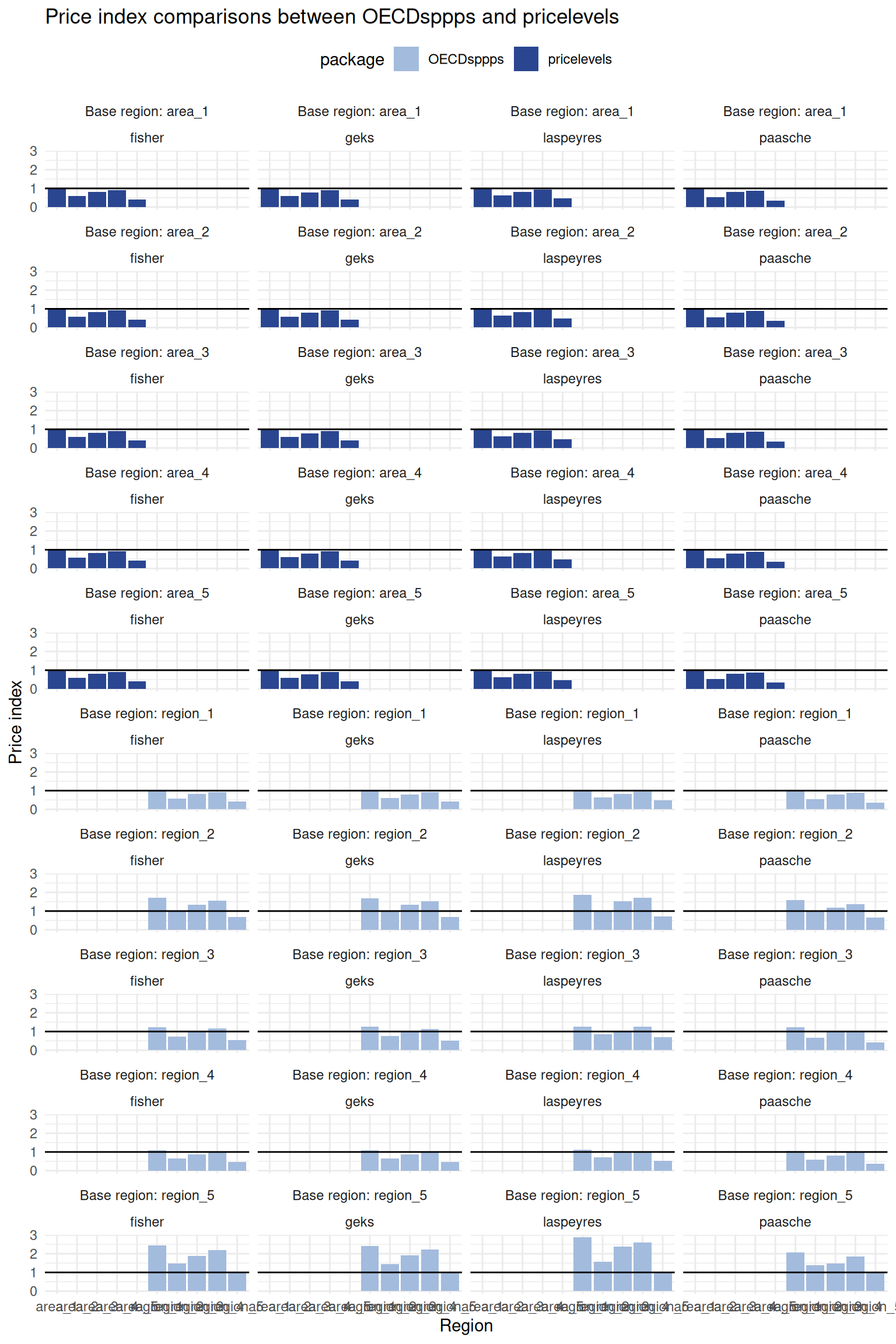
3 Putting it all together: Estimating weighted higher-level aggregates directly from item-level prices
As described in the implementation section, the CPD-GEKS approach is recommended for producing subnational PPPs by the ICP (ICP 2021), and has also been used by a national statistical institute in a subnational PPP programme, providing experimental statistics in Italy (Istat 2026).
This section describes how to implement this two-step procedure, which combines:
- Estimation of price parities at the basic-heading level using the regional extension of the Country-Product-Dummy (CPD) method (Summers 1973).
- Upon validation, aggregation of BH-level parities into higher-level indices using the Gini-Éltetö-Köves-Szulc (GEKS) method, a multilateral index construction technique that ensures transitivity, in combination with household final consumption expenditure data as a weighting structure for household final consumption PPPs (ICP 2021).
Most importantly, the CPI microdata typically does not contain price quotes for all COICOP categories, including the ones for which cross-regional uniform prices can be assumed, such as, for example, for used cars. However, removing products that are subject to uniform prices from the estimation will artificially inflate the price variation for any present category. Consider the example where a generic COICOP class contains 10 sub-classes, of which 9 are subject to uniform prices while one sub-class is subject to price variations. If the 9 uniform sub-classes were to be removed from the sPPPs calculation, the remaining sub-class with regional price variation would artificially inflate the price variation of the entire class. It is therefore necessary to artificially include uniform prices for all sub-aggregates contained within the respective higher aggregate for which sPPPs are estimated.
This can be done with the function estim_index_link(), which fills in missing basic heading PPPs with a value given by the user. The function returns a data frame containing the variables indicating the region (“region”), basic heading (“product”), basic-heading PPP (“ppp_bh”). Once joined with expenditure weights, this output can be directly fed into index_geks().3
The two steps above can be linked within one pipeline using the estim_index_link() function.
3.1 CPD estimation at the basic-heading level using item-level prices
Basic heading level sPPPs can be obtained from item-level price data by first grouping the data by basic heading with group_by(), then applying estim_cpd() to each basic heading with group_modify().
sampledata_prices %>%
  group_by(heading) %>%
  group_modify(~ {
    estim_cpd(.x,
      region = "region",
      product = "product",
      price = "price",
      output = "sPPP"
    )
  }) %>%
  ungroup() %>%
  head() %>%
  gt() %>%
fmt_number(decimals = 4)| heading | region | sPPP |
|---|---|---|
| heading_1 | region_1 | 1.0691 |
| heading_1 | region_2 | 1.3077 |
| heading_1 | region_3 | 1.0052 |
| heading_1 | region_4 | 0.7483 |
| heading_1 | region_5 | 0.9509 |
| heading_2 | region_1 | 1.0950 |
This will return a grouped tibble containing three columns: the variable specified by group_by() (in this case the basic heading “group”); region (“region”), and the subnational PPPs estimated via the CPD method (“sPPP”).
Note that the returned tibble is still grouped by the grouping variable specified in group_by(), which should be resolved with ungroup() before proceeding further.
3.2 Index calculation using basic-heading indices
GEKS (as well as Laspeyres, Paasche, Fisher, which are all nested within the GEKS function) indices can be calculated by linking the previous commands with index_geks() (as well as index_laspeyres(), index_paasche(), index_fisher()) through the estim_index_link() function.
estim_index_link() takes a data frame containing the basic heading sPPPs provided as an input argument data_sppps, and joins it with a second data frame (supplied via the argument data_weights) containing the household expenditure weights, and gives the user the option to impute price quotes for expenditure categories, for which household expenditure weights are present but no price quotes are available.
Thus, estim_index_link() returns a data object with all necessary variables for the calculation of the price indices, e.g., index_geks().
To summarise, the complete workflow has these three steps:
- Grouping item-level price data by basic heading, estimating basic heading sPPPs, and ungrouping the output data
- Preparing the data with
estim_index_link()for index number calculation - Estimating the final index numbers with
index_laspeyres(),index_paasche(),index_fisher(), andindex_geks()
sampledata_prices %>%
  # 1st step: grouping the data
  group_by(heading) %>%
  # 1st step: estimating the basic-heading sPPPs
  group_modify(~ {
    estim_cpd(.x,
      region = "region",
      product = "product",
      price = "price",
      output = "sPPP"
    )
  }) %>%
  # 1st step: ungrouping the output data
  ungroup() %>%
  # 2nd step: preparing the data for index number calculation
  estim_index_link(
    data_sppps = .,
    data_weights = sampledata_weights,
    product_heading = "heading",
    region = "region",
    sPPP = "sPPP",
    weights = "exp_wght",
    complete_sppp = NA
  ) %>%
  # 3rd step: Index number calculation
  index_geks() %>%
  # Previewing the results
  head() %>%
  gt() %>%
fmt_number(decimals = 4)| base_region | region | geks_index |
|---|---|---|
| region_1 | region_1 | 1.0000 |
| region_1 | region_2 | 0.5915 |
| region_1 | region_3 | 0.7921 |
| region_1 | region_4 | 0.9108 |
| region_1 | region_5 | 0.4122 |
| region_2 | region_1 | 1.6905 |
3.3 Incomplete input data
Unfortunately, the required input data is often incomplete and requires further processing before it can be used. Item-level price data can be validated through valid_pot(), valid_apt(), valid_ratio_xr(), and valid_ratio_ppp(). Expenditure weights can be validated through valid_est().
3.3.1 Missing price quotes
Basic heading sPPPs obtained from estim_cpd() may be incomplete for several reasons, such as missing price quotes for specific regions or uniform pricing across regions. In these cases, the above-outlined approach results in an error from index_geks() due to an incomplete sPPP matrix.
In the example below, we remove the sPPPs for two region/basic-heading pairs. While estim_index_link() returns a harmonised data frame, index_geks() returns an error.
Note that in the code chunk below, tryCatch() is used to print the error message returned by index_geks() as an output.
# Return error message ------
return_error <- function(expr) {
  tryCatch(expr,
    error = function(e) {
      message("Error message:\n", e)
    }
  )
}


return_error(
  sampledata_prices %>%
    group_by(heading) %>%
    group_modify(~ {
      estim_cpd(.x,
        region = "region",
        product = "product",
        price = "price",
        output = "sPPP"
      )
    }) %>%
    ungroup() %>%
    # Remove sPPPs for the following region/heading combinations: 1/1, 2/1
    filter(!(region %in% c("region_1", "region_2") & heading == "heading_1")) %>%
    estim_index_link(
      data_sppps = .,
      data_weights = sampledata_weights,
      product_heading = "heading",
      region = "region",
      sPPP = "sPPP",
      weights = "exp_wght",
      complete_sppp = NA
    ) %>%
    index_geks()
)
#> Error message:
#> Error in valid_index_data(data, region, product, ppp_bh, exp_wght, data_check_output): Incomplete PPP matrix.
#> Missing PPPs for the following region/product combinations:
#>  region_1/heading_1; region_2/heading_1
estim_index_link() enables imputing a user-specified value for missing sPPPs through the “complete_sppp” argument. The same value is imputed for all region/basic-heading pairs with missing sPPPs. The missing pairs are identified by estim_index_link() and do not have to be specified by the user. Below, we impute 1 for sPPPs of all such pairs. estim_index_link() also returns a warning listing all region/basic heading pairs for which the user-provided value was imputed.
sampledata_prices %>%
  group_by(heading) %>%
  group_modify(~ {
    estim_cpd(.x,
      region = "region",
      product = "product",
      price = "price",
      output = "sPPP"
    )
  }) %>%
  ungroup() %>%
  # Remove sPPPs for the following region/heading combinations: 1/1, 2/1
  filter(!(region %in% c("region_1", "region_2") & heading == "heading_1")) %>%
  # Setting complete_sppp = 1 to impute 1 for missing sPPPs
  estim_index_link(
    data_sppps = .,
    data_weights = sampledata_weights,
    product_heading = "heading",
    region = "region",
    sPPP = "sPPP",
    weights = "exp_wght",
    complete_sppp = 1
  ) %>%
  index_geks() %>%
  head() %>%
  gt() %>%
  fmt_number(decimals = 4)
#> [1] "sPPP of 1 was imputed for some region/headings pairs. To see the full list, set `complete_sppp_message == \"full\"."
#> Warning in estim_index_link(data_sppps = ., data_weights = sampledata_weights,
#> : sPPP of 1 was imputed for some region/headings pairs. To see the full list,
#> set `complete_sppp_message == "full".| base_region | region | geks_index |
|---|---|---|
| region_3 | region_3 | 1.0000 |
| region_3 | region_4 | 1.1508 |
| region_3 | region_5 | 0.5205 |
| region_3 | region_1 | 1.2573 |
| region_3 | region_2 | 0.7326 |
| region_4 | region_3 | 0.8690 |
3.3.2 Incomplete weighting matrix
Alternatively, the expenditure weights data frame can contain empty fields for some region/basic-heading combinations. estim_index_link() still works with such data and returns a standardised data frame. However, this data frame contains NAs for some region/basic-heading weights.
# Remove expenditure weight for the following region/heading combination: 1/1
sampledata_weights <- sampledata_weights %>%
  filter(!(heading %in% c("heading_1") & region %in% c("region_1")))

sampledata_prices %>%
  group_by(heading) %>%
  group_modify(~ {
    estim_cpd(.x,
      region = "region",
      product = "product",
      price = "price",
      output = "sPPP"
    )
  }) %>%
  ungroup() %>%
  estim_index_link(
    data_sppps = .,
    data_weights = sampledata_weights,
    product_heading = "heading",
    region = "region",
    sPPP = "sPPP",
    weights = "exp_wght",
    complete_sppp = NA
  ) %>%
  head() %>%
  gt() %>%
fmt_number(decimals = 4)| product | region | ppp_bh | exp_wght |
|---|---|---|---|
| heading_1 | region_1 | 1.0691 | NA |
| heading_1 | region_2 | 1.3077 | 0.0687 |
| heading_1 | region_3 | 1.0052 | 0.0687 |
| heading_1 | region_4 | 0.7483 | 0.0631 |
| heading_1 | region_5 | 0.9509 | 0.0673 |
| heading_2 | region_1 | 1.0950 | 0.0983 |
In turn, this causes the index number function to break and return an error due to an incomplete expenditure weights matrix.
Note that in the code chunk below, tryCatch() is used to print the error message returned by index_geks() as an output.
return_error(
  sampledata_prices %>%
    group_by(heading) %>%
    group_modify(~ {
      estim_cpd(.x,
        region = "region",
        product = "product",
        price = "price",
        output = "sPPP"
      )
    }) %>%
    ungroup() %>%
    estim_index_link(
      data_sppps = .,
      data_weights = sampledata_weights,
      product_heading = "heading",
      region = "region",
      sPPP = "sPPP",
      weights = "exp_wght",
      complete_sppp = NA
    ) %>%
    index_geks()
)
#> Error message:
#> Error in valid_index_data(data, region, product, ppp_bh, exp_wght, data_check_output):
#> Incomplete expenditure weights matrix.
#> Missing weights for the following region/product combinations:
#>  region_1/heading_1